
Table of Contents
What Services Does a Top-Rated Amazon Agency Offer?
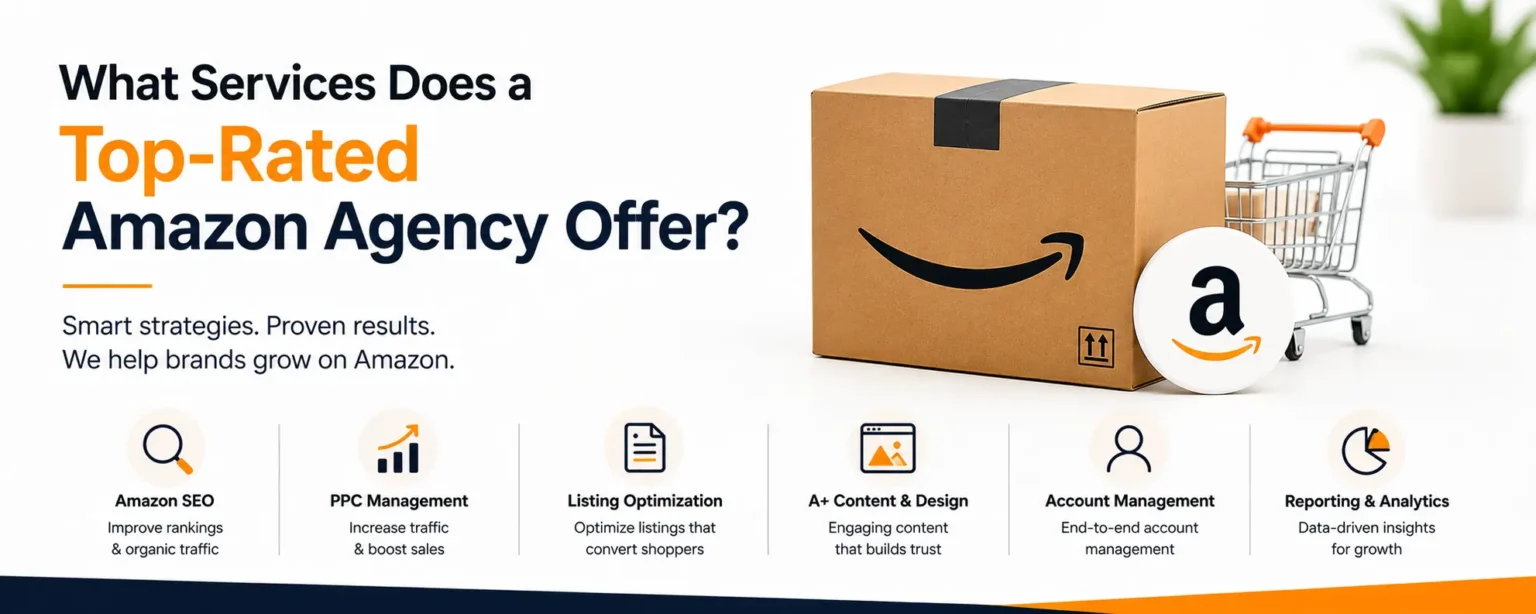
If you’re asking what services does a top rated amazon agency offer, the honest answer is: it depends on which agency you ask. Many Amazon agency websites use terms like “full-service” or “growth partner,” but when you actually dig into the contract, you find gaps. One firm handles PPC but sends you elsewhere for creative. Another builds listings but won’t touch your Seller Central account. The service scope varies so widely that “full-service” is often used inconsistently across agencies.
This article is a benchmarking tool. It breaks down exactly what a top-rated Amazon agency should deliver, service by service, so you can evaluate any firm against a clear standard. The strongest agencies integrate every one of these capabilities into a single coordinated growth system, and that distinction matters more than most brand owners realize until they’ve experienced the alternative. By the end, you’ll know what services to expect, what metrics to demand, how pricing typically works, and what questions to ask before you sign anything.
What services does a top rated Amazon agency offer: advertising that moves the revenue needle
Amazon PPC management: the engine behind consistent sales
A top Amazon agency manages end-to-end Sponsored Products, Sponsored Brands, and Sponsored Display campaigns. That means more than just turning campaigns on. It means building a campaign architecture segmented by funnel stage and purchase intent, setting automated bidding rules, maintaining aggressive negative keyword lists, and running weekly optimizations using the Search Term Report to harvest winning terms and cut waste.
The benchmark metric here is ACoS (Ad Cost of Sales). Well-managed campaigns across most categories land between 18% and 30%, though the right target depends on your product margin and category competitiveness. Health and supplements often run 30% to 45% given high CPCs, while electronics can sustain a leaner 12% to 28% ACoS. A quality agency tells you your target ACoS upfront and builds campaigns around it, rather than optimizing toward a generic number that ignores your margins.
When Amazon DSP enters the picture
Amazon DSP (Demand-Side Platform) enables programmatic display and video advertising for brands at scale. It unlocks retargeting for shoppers who viewed your product but didn’t buy, competitor conquesting against rival ASINs, and audience-based reach across Amazon’s owned properties and third-party sites. This is not a default service for every seller. DSP makes sense once a brand has established sales volume and wants to layer upper-funnel visibility on top of a performing Sponsored Ads foundation.
The critical detail is that strong agencies run DSP alongside Sponsored Ads as a coordinated strategy. When the two channels operate in silos, they compete for budget and produce contradictory data. When they reinforce each other, retargeting fills the gaps that Sponsored Ads miss and the combined impact on total sales accelerates measurably.
What services does a top rated Amazon agency offer: listing optimization and SEO that build organic rank
What listing optimization actually includes
Listing optimization is not just rewriting bullet points. A top agency conducts keyword research weighted by search volume, relevance, and purchase intent, then constructs titles within Amazon’s character limits, writes benefit-driven bullet copy, and populates every backend search term field available. The payoff compounds over time: a well-optimized listing earns organic traffic without additional ad spend, which drives TACoS (Total ACoS) down as overall revenue grows relative to what you’re spending on ads.
The best agencies also connect their listing keyword strategy directly to PPC. The highest-intent search terms from the Search Term Report feed back into listing content, and listing keywords seed new ad campaigns. That closed loop is what separates integrated agencies from those that treat SEO and advertising as separate projects handled by separate teams.
Conversion rate improvement as a distinct discipline
Ranking higher gets traffic to your page. Converting that traffic into sales is a separate problem. A well-run agency analyzes click-through rates, session data, and conversion rates at the individual ASIN level to identify specific gaps between the traffic arriving and the purchases completing. A product getting 1,000 clicks a week but converting at 5% is a different problem than one converting at 12% but receiving minimal traffic.
Changes to the main image, competitive pricing positioning, and review volume often affect conversion rate as much as keyword placement does. A quality agency tracks these variables and tests changes systematically rather than making assumptions about what shoppers respond to.
Creative services that convert browsers into buyers
A+ Content and Brand Story that reduce bounce rate
A+ Content transforms the lower portion of a product detail page from a plain text description into a branded visual experience. The standard module set includes comparison charts, enhanced lifestyle imagery, feature callouts, and Brand Story sections that communicate who the brand is and why the product exists. According to Amazon, Standard A+ Content typically lifts conversion rates 3% to 10% for brand-registered sellers, while Premium A+ Content, which unlocks interactive hotspots, embedded video, and full-width layouts, can push that improvement to 15% to 20% on high-traffic hero ASINs.
Many top agencies produce A+ Content in-house to preserve brand context rather than outsourcing it to a freelancer unfamiliar with the brand. This matters because the messaging in A+ Content needs to align with PPC ad copy, listing bullet points, and storefront content. Inconsistent messaging across touchpoints undermines the trust that converts browsers into buyers.
Amazon storefront design as a brand hub
A well-designed Brand Store does several things simultaneously. It supports Sponsored Brands campaigns by giving those ads a destination that showcases the full catalog in a branded environment. It drives external traffic from social media and influencer campaigns to a brand-controlled page rather than a generic Amazon search result. It builds the credibility that separates established brands from generic resellers.
What top agencies include in storefront builds: custom page architecture organized by product line, lifestyle imagery shot or curated for the Amazon format, product spotlight modules, and video content where available. Critically, a storefront is not a one-time build. A well-run operation updates it seasonally and around major promotional events so it stays current and supports the advertising calendar rather than sitting static for months.
Account operations and brand protection work behind the scenes
Seller Central management and catalog health
Daily Seller Central management is the work most brand owners severely underestimate until they’re doing it themselves. A full-service agency handles suppressed listing recovery, policy violation responses, Account Health dashboard monitoring, and case submissions with Amazon Seller Support. These tasks are not glamorous, but a suppressed ASIN can cause significant lost sales before anyone catches it.
Catalog operations extend beyond listings to variation management, ASIN creation, FBA shipment coordination, and inventory restock planning calibrated to sales velocity and seasonality. Stockouts are one of the fastest ways to lose organic rank that took months to build. A quality agency treats inventory coordination as a core function, not an afterthought.
Brand protection and Amazon Brand Registry support
Listing hijackers and unauthorized third-party sellers undercut your Buy Box ownership and compress pricing while eroding the brand reputation you’ve built. The best agencies monitor for these threats continuously and file enforcement actions through Amazon’s Brand Registry portal, which requires persistent follow-up to resolve. This is not a one-time setup, it’s ongoing account management.
Brand Registry enrollment is a prerequisite for A+ Content, Sponsored Brands access, and Brand Store setup. Agencies ensure clients are enrolled and compliant from the start, eliminating the delays that commonly push launch timelines back by weeks for brands that try to navigate enrollment on their own.
What to expect in deliverables, metrics, and pricing
Once you understand the service categories a top rated Amazon agency should cover, the next step is knowing how to evaluate performance and what you should pay for it. The two questions brand owners most often fail to ask upfront are what metrics the agency reports and how those metrics connect to actual business outcomes.
Performance metrics a quality agency tracks and reports
ACoS and TACoS are the two advertising efficiency metrics that matter most. ACoS tells you the cost efficiency of your paid campaigns in isolation. TACoS reflects the true relationship between total ad spend and total revenue, including organic sales. An account where organic rank is growing will show TACoS declining over time even as ad spend holds steady, the signal that the integrated strategy is compounding. Strong agencies report both metrics, not just ACoS, because an agency that obscures TACoS is often one whose advertising has no positive effect on organic performance.
A standard monthly report from a quality agency also includes ROAS, conversion rate by ASIN, organic rank movement on primary keywords, and Buy Box percentage. The delivery format matters too. The best firms provide custom dashboards with weekly check-ins rather than a single PDF at month’s end that leaves you guessing about what happened three weeks ago.
How Amazon agency pricing actually works
Three pricing models dominate the market:
- Flat monthly retainers run from $1,500 per month for entry-tier PPC-only management up to $15,000 or more for enterprise-level full-service engagements.
- Percentage of ad spend, typically 10% to 20% with a minimum floor of $1,000 to $2,500 per month, is common for advertising-focused arrangements.
- Hybrid models combine a lower base retainer with a performance incentive tied to revenue growth or TACoS improvement.
For most mid-market brands generating between $1M and $5M in Amazon revenue, a quality full-service retainer lands between $3,000 and $7,500 per month. Project fees for one-time work, such as a listing refresh, A+ Content build, or new product launch setup, tend to run $1,500 to $8,000 per engagement depending on scope and catalog size.
How to evaluate the right Amazon growth partner before you hire
Credentials and case studies that separate real agencies from resellers
Amazon Partner Network (SPN) membership and Amazon Ads certifications are the baseline technical validation to look for. Sponsored Ads Advanced and Amazon DSP certifications require passing a timed assessment at 80% or higher, and they expire annually, which means they reflect current platform knowledge rather than outdated training. SPN membership signals that the agency has cleared Amazon’s operational and security requirements to access the accounts of third-party sellers.
Case studies should show specific, measurable outcomes. Revenue lift percentages, ACoS reductions from a defined starting point, and organic rank improvements on named keyword targets are the kinds of data points that indicate a real agency. Vague testimonials that say “they really helped us grow” tell you almost nothing useful. Third-party ratings on platforms like Clutch or G2 with verifiable reviewer profiles add credibility that self-published testimonials cannot.
What integrated versus isolated service delivery looks like in practice
The biggest operational risk in hiring an agency is choosing one that manages PPC in a silo while a separate team handles listings and a third handles creative. Disconnected services produce contradictory strategies. Your ad campaigns drive traffic to a listing that hasn’t been updated to reflect current keyword opportunities. Your A+ Content uses different messaging than your Sponsored Brands headlines. Organic rank gains get undermined by ad campaigns targeting the wrong funnel stage.
The strongest agencies run all functions inside a single growth system. At ZIWLD, PPC, Amazon SEO, listing optimization, A+ Content, storefront design, and Seller Central management are structured as one coordinated strategy where every discipline reinforces the others. That structure is what prevents ad spend from being wasted on listings that don’t convert, and what allows organic rank gains to compound into durable, lower-cost revenue over time.
Starting with a free Amazon listing audit as a low-risk first step
Before committing to a full-service retainer, a listing audit surfaces the specific gaps in your current setup: keyword coverage relative to search volume, content quality against category standards, A+ Content status, catalog health issues, and advertising structure problems. It gives you a concrete picture of where the biggest opportunities are and what an agency would prioritize in the first 30 to 60 days.
ZIWLD offers a free listing audit for new and prospective clients, a low-risk entry point that shows exactly what an integrated agency approach would fix first, with no contract required to get started.
Use this as your agency evaluation checklist
A top-rated Amazon agency delivers advertising, SEO, creative, and account operations as an integrated system, not as isolated services sold separately, and not as disconnected specialists stitched together under one invoice. The services covered here, from PPC campaign architecture and Amazon SEO to A+ Content, brand protection, and Seller Central management, represent the full scope that serious brands should demand from any agency they consider.
Now that you have a clear picture of what top-tier Amazon agency services actually look like, you have a direct checklist to evaluate any firm you’re considering. Use it to hold out for a partner that can genuinely deliver all of it under one roof. Start with a free listing audit to see where your Amazon presence stands today, then measure every agency against the full-service standard outlined here.
Frequently asked questions
Starting with a free Amazon listing audit as a low-risk first step
At minimum, look for end-to-end PPC management (Sponsored Products, Sponsored Brands, Sponsored Display), listing optimization and Amazon SEO, A+ Content and storefront design, Seller Central account management, and brand protection. The differentiator is whether those services operate as a coordinated system or as disconnected offerings managed by separate teams.
How much do full-service Amazon agencies charge?
Most full-service Amazon agencies charge between $3,000 and $7,500 per month for mid-market brands generating $1M to $5M in Amazon revenue. Entry-tier PPC-only management starts around $1,500 per month, while enterprise-level engagements can exceed $15,000 per month. Percentage-of-ad-spend models typically run 10% to 20% with a monthly minimum floor.
What is the difference between ACoS and TACoS?
ACoS (Ad Cost of Sales) measures the efficiency of your paid advertising in isolation, ad spend divided by ad-attributed revenue. TACoS (Total ACoS) divides total ad spend by total revenue including organic sales, giving you a clearer picture of how advertising contributes to overall business growth. A declining TACoS over time indicates that organic rank is improving, which is the goal of an integrated Amazon growth strategy.
What credentials should I look for when hiring an Amazon agency?
Look for Amazon Partner Network (SPN) membership, Amazon Ads certifications (Sponsored Ads Advanced and Amazon DSP), and verifiable case studies with specific metrics. Third-party reviews on platforms like Clutch or G2 add independent credibility beyond what an agency self-reports on its own website.