
Table of Contents
What a Full-Service Amazon Agency Does for Your Brand
Here’s a situation most brand owners know too well: a PPC freelancer running ads, a VA managing listings, and a designer on retainer for A+ Content, yet still no one coordinating the whole picture. Sales plateau. Ad spend bleeds. And when something breaks, everyone points at someone else. That’s the structural problem a full-service Amazon agency is built to solve. So if you’ve ever asked yourself, “What does a full-service Amazon agency do for my brand?”, this article answers that question in full, from services and pricing to onboarding timelines and how to vet the right partner before signing anything.
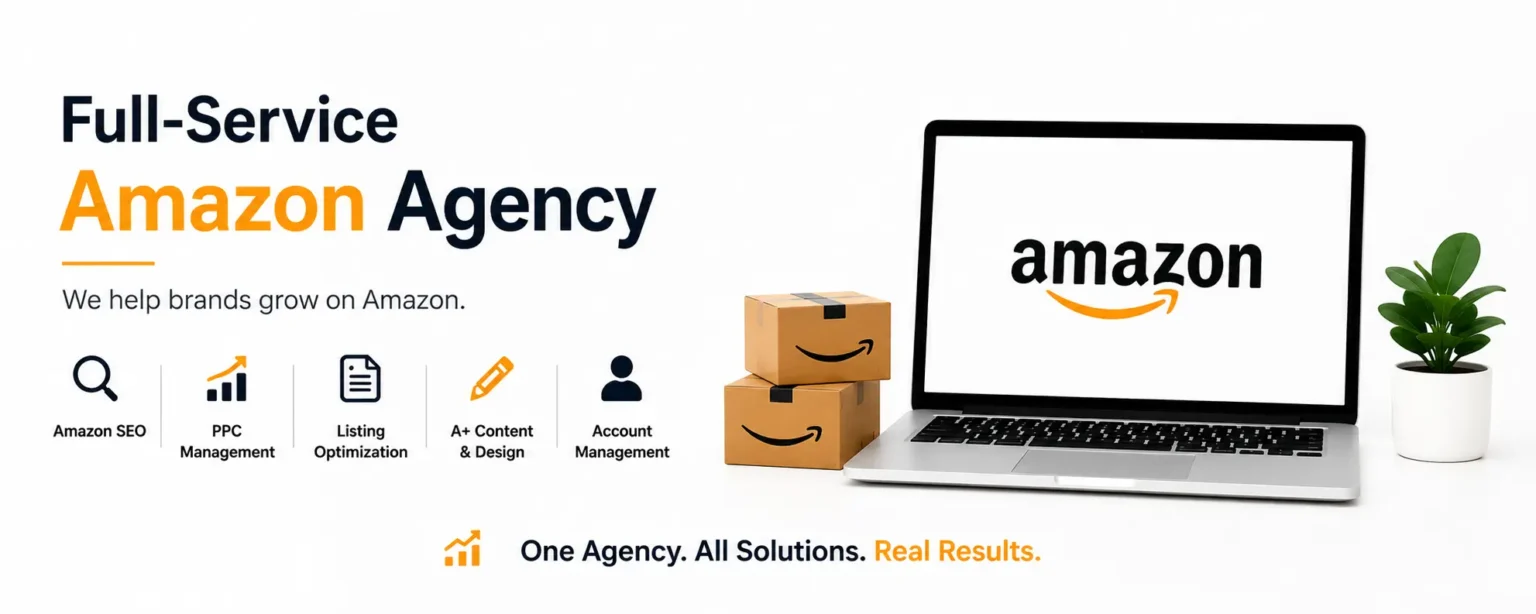
Full-service means one team managing every growth lever under a single, coordinated strategy. At ZIWLD, that’s the entire model: PPC, SEO, creative, and catalog operations working as one system rather than isolated tasks spread across different vendors. The difference between those two approaches shows up clearly in the numbers, and we’ll get to those shortly.
This article breaks down every function a full-service Amazon agency manages, what results brands should realistically expect, how pricing works, what onboarding looks like, and how to vet the right partner before signing anything.
The Full Scope of What a Full-Service Amazon Agency Does for Your Brand
Most brand owners assume “agency” means PPC management. That assumption costs them. A full-service engagement covers every function required to grow a brand on Amazon, not just the advertising layer. Here’s what Amazon brand management actually looks like when it’s done right.
Amazon PPC and Paid Advertising
Managed advertising goes well beyond switching campaigns on and setting a daily budget. A competent agency handles Sponsored Products, Sponsored Brands, Sponsored Display, and DSP campaign management with full keyword segmentation, negative keyword hygiene, and bid strategy built around your margin targets. Search term reports feed directly back into listing copy and SEO strategy, so paid data compounds into organic performance over time.
Listing Optimization and Organic SEO
Amazon listing optimization is more than rewriting bullet points. It includes structured keyword research, title architecture, backend search term targeting, and ongoing rank tracking across priority keywords. The outcome brand owners care about is organic rank, and that only improves when listings are built around the search terms shoppers actually use, not just the ones a brand thinks matter.
Creative Assets That Convert Browsers into Buyers
A+ Content, Brand Story, infographics, product photography direction, and Amazon storefront design all fall under the creative layer. These assets directly influence conversion rate, which in turn affects both organic ranking and ad efficiency. A listing with strong creative needs less ad spend to hit a profitable ACoS because it closes more of the traffic it receives.
Catalog Health and Account Operations
This is the unglamorous work most freelancers skip. Catalog health monitoring, variation setup, listing suppression resolution, inventory coordination, and Seller Central compliance issues don’t generate impressions or clicks, but they do prevent revenue leaks that quietly drain profitability. A suppressed listing or a broken variation can cost a brand thousands of dollars per day before anyone notices.
Why an Integrated Amazon Seller Agency Outpaces Fragmented Vendors
When PPC, SEO, and creative operate in silos, they work against each other. An ad driving traffic to a poorly optimized listing burns budget. A beautifully designed A+ Content page built without keyword research misses organic reach. The individual vendors may look fine on paper, but the brand pays for the coordination gap.
The Cost of Running Disconnected Services
Consider a brand running a PPC freelancer, a separate copywriter for listings, and a design agency for A+ Content. Each vendor optimizes for their own deliverable. Nobody owns the ROAS. Nobody owns the ACoS. Spend increases, conversion holds flat, and the brand ends up in a meeting trying to figure out which vendor is responsible for the performance gap. In most cases, all three are doing acceptable work in isolation. The problem is structural, not individual, and no amount of tweaking individual deliverables fixes a broken coordination model.
How an Integrated Strategy Compounds Results
When PPC data informs keyword targeting in listings and conversion rate improvements from A+ Content reduce the cost-per-click needed to hit a profitable ACoS, every function amplifies the others. At ZIWLD, this compounding effect is the foundation of the growth system. Advertising data feeds SEO decisions, which reduce advertising costs over time. Creative improvements lift conversion, which improves organic rank and reduces dependence on paid traffic. The flywheel turns faster when all the inputs are coordinated by one team with a shared goal.
What Measurable Results to Realistically Expect
Specific numbers matter here, because vague promises of “growth” don’t help you evaluate an agency’s track record. The figures below come from documented full-service Amazon account case studies, though results vary by category, competition level, and the quality of the integrated strategy behind the campaigns.
ACoS and ROAS Improvements
ACoS reductions across documented agency case studies range from 22% on the conservative end to 65% in stronger turnarounds. Specific data points include ACoS dropping from 31% to 24% after a full-service restructure, from 44% to 19% after eliminating wasted spend, and from 71% to 18% in an aggressive PPC overhaul. ROAS trajectories commonly move from the 3.35 range to 5.0 and above. These are ranges, not guarantees, and outcomes depend heavily on the quality of the integrated strategy behind the campaigns.
Sales Lift and Conversion Rate Gains
Sales growth data from full-service agency engagements is wide-ranging. A 42% year-over-year lift in six months represents a solid but conservative outcome. Stronger cases show 250% growth over the same period. One brand moved from $84,000 to $437,000 in monthly revenue after a full-funnel rebuild. Conversion rate improvements are just as significant: A+ Content split testing produced a 30% conversion lift in one documented case, while a combined listing and PPC rebuild pushed conversion from 9.2% to 21.7% in another. These outcomes are achievable, but they require full-service integration, not a partial engagement.
How Full-Service Amazon Agency Pricing Actually Works
Many brand owners avoid agency conversations because they don’t know what they’re walking into. Pricing transparency removes that barrier and helps you benchmark what you’re being offered against the market.
The Three Common Pricing Structures
Most full-service agencies use one of three models. The percentage-of-ad-spend model runs 10 to 20% of monthly Amazon ad spend, usually with a minimum floor around $1,000 to $2,500 per month. Flat monthly retainers range from $1,500 to $8,000 per month for small-to-mid-size accounts and $4,000 to $15,000 per month for full-service mid-market brands. The hybrid model combines a base retainer with a performance bonus tied to revenue growth above a baseline, typically 2 to 5% of attributed revenue above an agreed threshold.
What You Actually Get at Each Price Tier
Lower-priced engagements in the $1,500 to $3,000 range almost always cover PPC management only. Full-service packages including listing optimization, creative production, catalog operations, and reporting typically fall in the $3,000 to $15,000 per month range, depending on catalog size, ad budget, and operational complexity. The right question isn’t which agency is cheapest; it’s which agency’s scope matches what your account actually needs to grow.
The 90-Day Onboarding Roadmap from Kickoff to Optimization
Many brands get frustrated in month one because they expect results before the strategy is even built. Understanding the 90-day window sets realistic expectations and helps both sides stay aligned during the ramp-up phase.
Days 1 to 30: Access, Audit, and Strategy
The first 30 days involve account access setup, a full account audit covering listing health, ad structure, keyword gaps, and competitor benchmarking, then delivery of a written growth roadmap. This phase requires active client involvement: brand guidelines, prior performance data, and budget parameters all need to come from your side early. Expect 5 to 10 hours per week of collaboration during this window. The agency can’t build an accurate strategy without knowing your goals, your margins, and your competitive positioning.
Days 30 to 90: Execution, Refinement, and Early Results
Execution begins around day 30, starting with listing rebuilds, PPC campaign restructuring, A+ Content production, and storefront updates launching in parallel. By day 60, the agency has early performance data to refine campaigns and optimize spend allocation. Days 60 to 90 are when the compounding effects start to show: improving conversion rates, lower wasted spend, and the beginning of organic rank movement from the listing and keyword work done in weeks three through six. Organic rank improvements typically become measurable 4 to 8 weeks after listing optimization goes live.
How to Vet and Pick the Right Amazon Marketing Agency for Your Brand
The right agency asks about your goals before quoting a price. That single behavior tells you whether you’re talking to a growth partner or a vendor pitching a fixed package. There are also specific credentials and red flags worth knowing before you evaluate anyone.
Certifications and Credentials That Signal Real Expertise
Amazon Ads certifications are the clearest signal of technical competency. The four that matter most for a full-service engagement are the Sponsored Ads Certification, the Sponsored Ads Advanced Certification, the Amazon Retail for Advertisers Certification, and the DSP Certification for agencies pitching programmatic work. Critically, these certifications should be held by multiple team members, not just the founder or one senior strategist. Ask for the names of the certified individuals, the exact certifications they hold, and when each was earned or last renewed. A badge image on a website is not sufficient verification.
Red Flags That Reveal the Wrong Fit
Watch for agencies with only one certified team member, vague claims of Amazon affiliation without documentation, or a mismatch between what they’re selling and what their credentials actually cover. An agency pitching DSP strategy with only Sponsored Ads certifications is overselling its capability. Equally, an agency that can’t show case studies tied to the specific service they’re proposing has a gap in its proof. The right partner offers a free account audit before asking for a commitment. At ZIWLD, a free Amazon listing audit is the starting point for every new client conversation, because it lets both sides see the real opportunity before any contract is on the table.
Frequently asked questions
What does a full-service Amazon agency do for my brand that a freelancer can't?
A freelancer typically owns one function, ads, copy, or design. A full-service Amazon agency owns the entire growth system. That means PPC data feeds listing strategy, creative improvements reduce ad costs, and catalog operations prevent revenue leaks no single vendor is responsible for catching. The compounding benefit of coordination is the core difference.
How long before I see results from a full-service Amazon agency?
Most brands see early performance signals by day 60. Meaningful organic rank movement typically becomes measurable 4 to 8 weeks after listing optimization goes live. Full compounding effects, where advertising, SEO, and creative reinforce each other, generally show clearly by the end of a 90-day engagement window.
What's the average cost of a full-service Amazon agency?
Full-service engagements covering listing optimization, creative production, PPC management, and catalog operations typically range from $3,000 to $15,000 per month, depending on catalog size, ad budget, and complexity. PPC-only engagements run lower, in the $1,500 to $3,000 range, but don’t include the integrated services that drive compounding growth.
What should I look for when evaluating an Amazon seller agency?
Prioritize agencies that ask about your goals before quoting a price, hold multiple Amazon Ads certifications across their team, and can show case studies with real performance numbers tied to the specific services they’re proposing. A free audit before any commitment is a strong positive signal.
The Decision Comes Down to Structure
When you ask what a full-service Amazon agency does for your brand, the honest answer is this: it replaces a fragmented vendor stack with a coordinated growth system. When PPC, SEO, creative, and catalog operations run as one integrated strategy, each function makes the others more effective. Brands running disconnected vendors will always be playing catch-up against brands operating with integrated systems, because the compounding benefit of coordination accrues over time, and that gap widens every month.
Evaluate any Amazon marketing agency by the breadth and coordination of their services, not just their ad management capability. Ask for certifications, request case studies with real numbers, and choose a partner who understands your full funnel from the first conversation. Pricing matters, but fit and scope matter more.
If you want to see exactly where your account has room to grow before committing to a partnership, ZIWLD’s free Amazon listing audit is the right place to start. One conversation gives you a clear picture of what’s working, what’s leaking, and what a full-service coordinated strategy could unlock for your brand. Request your free audit today.