
Table of Contents
Amazon PPC vs Organic SEO: Your New Product Launch Guide
Your product is live. The listing looks clean. And nothing is moving. This is the exact moment most brand owners split into two camps: the ones who immediately start running ads and the ones who convince themselves the listing just needs more optimization first. Both instincts are incomplete, and acting on either one alone is how launches stall.
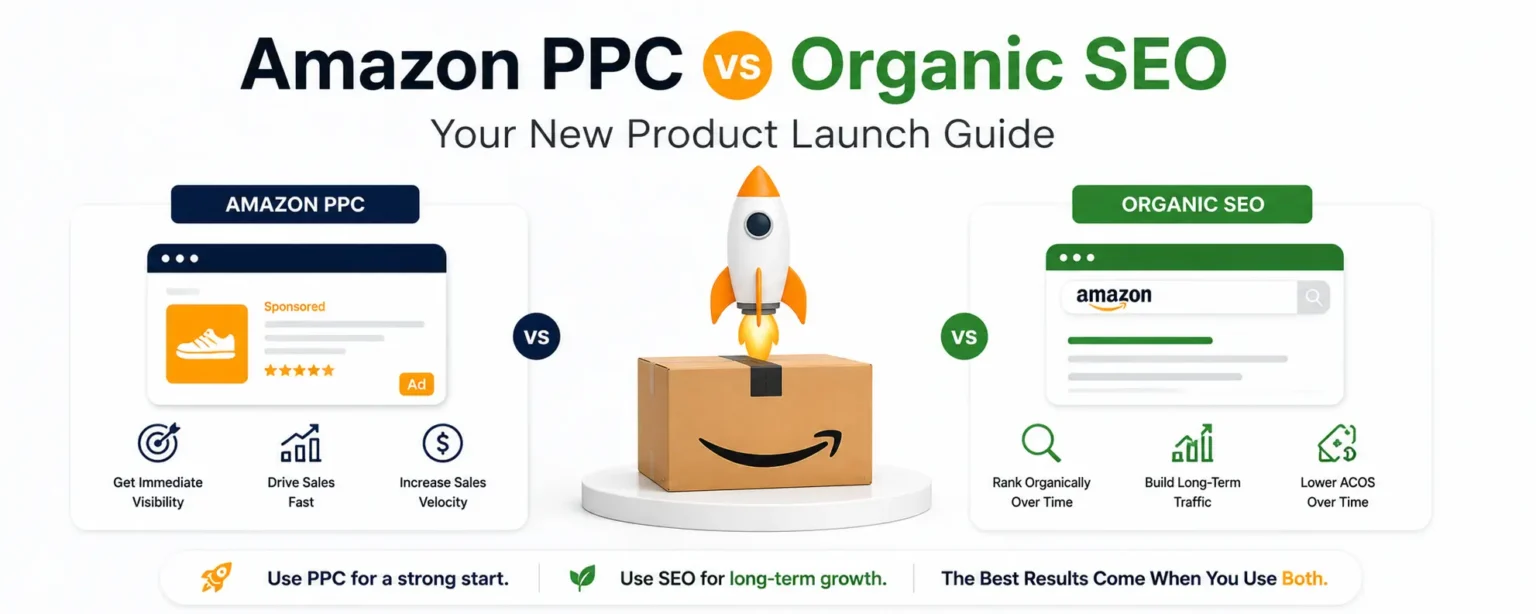
So which is more effective, Amazon PPC or organic SEO for new products? Based on practitioner consensus and multiple case studies, the answer is clearly both, coordinated and integrated from day one. PPC generates the sales velocity Amazon’s algorithm requires before it will rank a new listing organically. Organic SEO ensures the listing converts that paid traffic efficiently enough for the velocity to actually build rank. Pull either one back and the other underperforms. This is the integrated approach growth teams like ZIWLD use with every product launch, and this article breaks down exactly how it works across the first 90 days.
Which Is More Effective for New Products: Amazon PPC or Organic SEO?
The short answer: neither works well without the other. Amazon’s A9/A10 algorithm, based on practitioner-observed signals including historical sales performance, keyword relevance, and conversion rate, gives new listings no organic advantage at launch. A brand-new listing has zero sales history, so organic discoverability starts near zero regardless of how well the listing is written. PPC is the mechanism that creates the first velocity signal. Without it, a new product lands at the back of search results with very low organic visibility and may never accumulate the click volume needed to build rank at all.
A launch ACOS of 30, 60% is not a campaign failure, it reflects the cost of purchasing the velocity that builds organic rank. Brands that see 45% ACOS in week two and pull spend are cutting off the mechanism before it has a chance to work. The goal in launch mode is not profitability yet. It is rank-building, and PPC is how you pay for it.
How PPC creates the sales velocity Amazon needs to notice your listing
Sponsored Products generate initial impressions and conversions tied to specific search terms. Each sale from a keyword-targeted ad sends a relevance signal associating your ASIN with that search term. Amazon begins indexing the listing more strongly for those terms as conversion data accumulates. Agency and case-study data consistently shows that new launches often run 70, 90% of early units through paid ads before organic rank develops enough to carry meaningful volume. That is not a problem to solve. That is the design.
The relationship between PPC sales velocity and organic rank improvement is strongest when ads drive sales on the exact target keywords you care about. Generic traffic that does not convert well creates impressions without the relevance signal that actually moves rank. This is why campaign structure during launch matters: broad match and automatic campaigns should be mining for converting terms, not just generating impressions.
ACOS benchmarks that tell you if launch spend is performing or failing
Category context matters when evaluating launch ACOS. Beauty and supplements often run 35, 60% or higher during launch. Home and kitchen typically lands in the 30, 60% range. Electronics generally sits between 30, 50%. These numbers reflect competitive intensity and margin structure, not poor campaign management. What actually tells you whether the launch is working is TACoS, total advertising cost of sales across all revenue, not ACOS alone.
TACoS trending down over 60, 90 days while revenue holds or grows is the proof your launch is working. A successful launch commonly moves from 30, 40% TACoS in the first month toward 20, 25% by mid-period and 10, 20% by day 90. That declining trend signals that organic rank is improving and paid dependency is decreasing. If TACoS is flat or rising after 60 days, the listing or campaign structure needs attention.
How organic SEO compounds, and why it can't wait until after launch
Organic ranking on Amazon is a compounding process that starts building signals the moment a listing goes live. The keywords in your title, bullet points, backend search terms, and A+ Content all inform how Amazon indexes and tests the listing early. If those elements are weak or missing on day one, PPC spend runs against a listing that converts below category average, which raises ACOS and slows rank-building. You end up paying more for the same velocity signal.
A fully optimized listing does two things at once: it gives PPC campaigns the conversion rate they need to stay efficient, and it accumulates organic relevance signals in the background from the very first sale. Skipping listing optimization to handle it later means rebuilding on a foundation that already sent weak signals to the algorithm. The compounding effect works for you or against you from day one. There is no neutral position.
The 60, 90 day organic rank reality for new listings
Amazon typically indexes new listings within the first 1, 14 days. Meaningful organic rank movement often begins in weeks 2, 8, and stable, sustainable rank in competitive categories generally takes 60, 90 days, sometimes longer. Some practitioners reference a honeymoon period of extra visibility in the first 30 days for new listings, a window that only compounds into lasting rank if sales and conversion data are strong during it. Without PPC generating early velocity, that window expires with nothing to show.
Lower-competition, long-tail keywords can move in 2, 4 weeks. Competitive categories may take 3, 6 months to rank well on primary terms. This is why the first 90 days represent the highest-leverage window of a product’s commercial life on Amazon. The actions taken, or not taken, during this window determine whether the listing builds lasting organic rank or stays permanently dependent on paid spend.
What Amazon's algorithm actually rewards in a new listing
Amazon SEO is not about keyword stuffing. Based on practitioner analyses, the algorithm rewards title relevance, backend keyword coverage, conversion rate above category benchmarks, and review accumulation speed. Conversion rate appears to be a particularly strong lever in A10-style ranking behavior: a listing converting at 15% on moderate traffic can outrank a competitor converting at 5% on higher traffic. Conversion quality matters more than raw click volume.
A+ Content does not directly boost rank, Amazon has not publicly documented a direct ranking effect, but it consistently lifts conversion rate, which does influence rank. That makes creative quality a performance input, not a cosmetic choice.
What actually happens when brands bet on just one channel
These two failure patterns show up repeatedly across practitioners and case studies. Both are avoidable with the right launch structure.
The PPC-only trap: high spend, no compounding value
A brand launches with strong ad spend but minimal listing optimization. The title is generic, the images are standard, and A+ Content is missing. PPC drives impressions, but conversion rate sits below category average. ACOS runs at 55, 70% and never improves because each paid click converts too infrequently to build a strong relevance signal. After 90 days, organic rank is still near zero. The brand keeps spending to sustain any sales volume at all. Every dollar is paying for rent, not building equity. This wastes the entire window where early momentum compounds fastest.
The organic-only gamble: optimized listing, no sales signal
A brand invests in professional photography, a fully optimized listing, and A+ Content, but launches without PPC. The listing is excellent by every creative measure. Organic rank starts on page eight or worse. Impressions are near zero because Amazon has no reason to surface a listing with no sales history. After 60 days, no meaningful sales data has accumulated because shoppers never found the product. The listing sits in limbo, perfectly crafted and commercially invisible. The window for building early momentum closes, and catching up later requires far more spend than a coordinated launch would have cost.
A 90-day integrated launch sequence built for both channels
The budget starting point for a standard launch is roughly 30, 35% of projected monthly revenue allocated to PPC, or approximately $10, $30 per campaign per day as a leaner entry point. Practitioners recommend a minimum of 20, 30 clicks per day per campaign to collect statistically usable conversion data. Below that threshold, optimization decisions are based on noise, not signal. With those parameters in place, the launch unfolds in three distinct phases.
Days 1, 30: Building the velocity foundation
PPC launches on day one with automatic and broad match campaigns targeting 20, 30 clicks per day per campaign. The objective is keyword discovery and initial sales velocity, not profitability. Simultaneously, the listing is already fully optimized: primary keyword in the title, backend terms populated, A+ Content live, and images conversion-tested. These two systems run in parallel. PPC buys clicks that generate the first sales signals. The optimized listing converts those clicks above category average, maximizing the organic rank value of each paid sale. Neither system can do its job without the other during this phase.
Days 31, 60: Reading the data to sharpen what's working
Pull the search term report and identify which keywords are converting at the lowest ACOS. These become the basis for exact match campaigns with stronger bid allocation. Keywords spending without converting become negative keywords immediately.
On the organic side, monitor which search terms the listing is beginning to rank for naturally. If those terms also show strong PPC conversion, allocate more bid budget there to reinforce the relevance signal. Begin tracking TACoS weekly during this phase. A declining TACoS with stable or growing revenue confirms that organic rank is improving and the integration is working as designed.
Days 61, 90: Letting organic rank carry more weight
Well-performing ASINs should show measurable organic rank improvement on priority keywords by this phase. Begin reducing bids on campaigns where organic rank has risen to page one or two. The goal is to reduce TACoS without losing revenue, proof that organic is beginning to substitute for paid volume. Continue funding campaigns aggressively on keywords where organic rank remains weak. The transition from paid dependency to organic contribution is gradual and keyword-specific, not a single hard cutoff across all campaigns.
How to measure whether your launch is working or just spending
ACOS measures paid efficiency in isolation. It tells you nothing about whether organic rank is improving or whether total profitability is moving in the right direction. True launch health requires looking at paid and organic performance together, using metrics that reflect the relationship between the two channels.
TACoS, organic rank, and conversion rate: the three metrics that matter
TACoS, calculated as total ad spend divided by total revenue, not just ad-attributed revenue, is the most honest signal of launch progress. A launch trending from 40% TACoS in month one to 25% in month three while maintaining or growing revenue indicates organic rank is growing and paid dependency is falling. Pair TACoS with keyword rank tracking on 10, 15 priority terms and monitor those rankings weekly. Conversion rate should stay at or above category benchmark throughout the launch window. If conversion rate drops, revisit the listing and creative before increasing bids. Adding spend to a listing with a declining conversion rate accelerates the problem, not the solution.
How coordinated launch planning removes the guesswork from both channels
The core challenge with running Amazon PPC and organic SEO simultaneously is that most brands manage them as separate workstreams with separate owners and no shared feedback loop. The search term data that PPC generates is exactly the data that should inform listing optimization updates. The organic rank data should directly control PPC bid decisions. When these systems operate in silos, brands either over-invest in ads without improving the listing or optimize the listing without enough traffic data to know what is actually converting.
ZIWLD structures launch engagements around this feedback loop from week one, reading ad campaign data and listing performance data together and acting on both simultaneously. This ensures the TACoS trend reflects a compounding launch rather than a flat spend curve with no organic payoff. For brands that want a structured, data-driven launch plan that manages both channels as one integrated system, reach out to ZIWLD to get started.
The launch window is the leverage point
Amazon PPC or organic SEO for new products, it is not an either/or decision. They are two systems that need each other to function. PPC buys the early velocity that organic ranking requires. Organic SEO converts that paid traffic efficiently enough for the velocity to actually build rank. Run one without the other and you pay for results that never fully arrive.
The 90-day window after launch is the highest-leverage period in a product’s commercial life on Amazon, and the period most brand owners underuse by treating PPC and SEO as separate decisions made at separate times. Getting the integration right from day one is what separates a product that builds lasting organic rank from one that stays permanently dependent on ad spend. The difference is not budget size. It is whether both channels are coordinated, measured together, and optimized as a single system from the moment the listing goes live.
Frequently asked questions
Which is better for a new Amazon product launch: PPC or Organic SEO?
Both strategies are important. Amazon PPC helps generate immediate traffic and sales, while Organic SEO improves long-term rankings and sustainable visibility. Using both together delivers the best results for a successful product launch.
How long does Amazon Organic SEO take to show results?
Amazon Organic SEO usually takes several weeks or months, depending on your competition, keyword strategy, listing quality, and sales performance. Consistent optimization helps improve rankings over time.
Should I stop Amazon PPC after my product starts ranking organically?
No. Even if your product ranks organically, Amazon PPC can help maintain visibility, protect your rankings, and reach more potential customers. Many successful Amazon sellers use both strategies together.
Can Amazon PPC improve my organic rankings?
Yes. A well-managed Amazon PPC campaign can increase product visibility, generate more sales, and improve customer engagement. These performance signals may contribute to better organic rankings over time.
How can ZIWLD help with Amazon PPC and Organic SEO?
ZIWLD provides professional Amazon PPC management, Amazon SEO, listing optimization, keyword research, and account management services to help sellers launch products successfully, improve rankings, and increase long-term sales.