
Table of Contents
Amazon Product Launch Playbook: Your 2026 Strategy
What is the best strategy to launch a product on Amazon in 2026? For many sellers, that question gets answered the hard way: a large share of new ASINs earn fewer than 10 reviews in their first month and never crack page one, not because the product is weak, but because the launch sequence is. The sellers who gain early traction in 2026 frequently aren’t selling better products; launch execution explains the difference more often than marginal product advantages do.
Having coordinated launches across dozens of Amazon categories, the difference between a launch that builds momentum and one that flatlines comes down to a handful of decisions made in the right order. Amazon’s algorithm rewards conversion rate, sales velocity, and relevance above everything else. If any of those three signals is weak during your launch window, the whole system stalls.
Start here before spending a dollar on ads. This playbook covers five areas in sequence: why launches stall before the first sale, how to build a launch-ready listing, which creative assets drive conversion, how to structure your first-week PPC without burning budget, and how to use promotions and reviews to fuel early velocity. Read through all five before you go live.
Why Most Amazon Launches Stall Before the First Sale
Before sales velocity or conversion rate matter, Amazon’s ranking system runs a relevance check. If your listing doesn’t index for the right search queries, no amount of PPC spend corrects for that gap. The 2026 ranking framework treats keyword relevance as the entry gate, with conversion rate and sales velocity determining where you land once you’re inside the eligible set. Many new launchers skip this foundational step entirely and go straight to advertising.
The reactive launch pattern looks like this: publish the listing, turn on broad-match campaigns, and wait for momentum to build. Instead, clicks arrive that don’t convert. Low conversion tells the algorithm the listing isn’t relevant. CPCs climb. Budget drains without improving organic rank. That spend spiral is avoidable, but only if listing quality and keyword seeding happen before the first ad goes live. The sequence matters more than the budget size.
Building the Launch-Ready Listing: Keyword Seeding and SEO Structure
How to Structure Keywords Across Your Listing
Start keyword research before the listing is written. For a 2026 Amazon launch, the goal is indexing coverage across your most relevant search queries, not keyword density. Lead your title with the highest-volume, highest-relevance term buyers actually search. Tier secondary and long-tail terms into bullet points and the backend search terms field. Amazon’s algorithm cross-references query intent against listing content, so natural placement in the right fields consistently outperforms stuffing.
Think of the title, bullets, and backend as three distinct layers of a relevance map. The title earns your spot in the most competitive searches; it should include the primary keyword phrase and the top two or three attributes buyers filter by, size, material, or use case. Bullet points should address the five most common pre-purchase objections while reinforcing secondary keywords. The backend captures everything that wouldn’t fit naturally in visible copy. Together, these three layers determine which searches your listing is eligible to appear in at all.
Validating Demand Before You Build the Listing
Before committing to a full launch, run a quick product validation pass: confirm demand exists at a price point that works for your unit economics, review the top 10 to 20 search results for your primary keyword to understand review depth and listing quality you’ll be competing against, and calculate your landed cost against expected selling price to verify margin before ordering inventory. A listing built on a validated demand signal has a structural advantage over one that skips this step, the keyword choices and positioning reflect what buyers are actually searching for, not what the brand assumes they want.
FBA is the fastest path to Buy Box eligibility for new ASINs. New listings have no fulfillment history, and Amazon evaluates Buy Box ownership using metrics your listing hasn’t had time to earn yet: Order Defect Rate below 1%, Late Shipment Rate below 4%, and Valid Tracking Rate above 95%. FBA satisfies those thresholds because Amazon handles fulfillment directly. For FBM sellers, hitting those numbers from day one is non-negotiable. Set your landed price competitively within the category range; the algorithm evaluates price relative to alternatives, not in isolation.
Creative Conversion Assets That Do the Selling for You
Your main image must meet Amazon’s 2026 requirements: pure white background (RGB 255,255,255), product filling at least 85% of the frame, and a minimum of 1,000 pixels on the longest side (the official threshold for zoom quality). In practice, 2,000+ pixels is the recommended standard because it delivers noticeably sharper zoom at typical monitor resolutions. The main image is just the entry point. A full conversion-focused image set uses six to eight images: a hero shot, a key benefit infographic, a lifestyle or use-case image, a close-up of materials or features, a size or comparison chart, and a packaging or in-box contents shot. Add a short product video and you’ve answered every question a buyer might have before adding to cart.
A+ Content doesn’t directly boost organic rank, but it measurably improves conversion rate, which does feed ranking. For a new ASIN, getting A+ Content live before launch day means the listing is already optimized for conversion when paid traffic arrives. The module types that perform best for first-time buyers are comparison charts, brand story modules, and feature highlight layouts. Brand Registry enrollment is a prerequisite, put it on the pre-launch checklist, not as an afterthought after going live. Expect A+ Content to publish within about a week of submission, with a reliable conversion signal visible after roughly four to six weeks of traffic.
A branded Amazon storefront acts as a trust multiplier, especially when buyers click through from Sponsored Brands ads. A clean two-to-three page storefront with organized category pages, lifestyle imagery, and cross-sell sections reinforces the brand signal that Amazon’s algorithm increasingly factors in through Brand Registry association. For launch purposes, even a minimal storefront is better than none.
First-Week PPC Structure That Builds Velocity Without Burning Budget
The Three-Campaign Launch Setup
A structured launch campaign setup uses three distinct campaigns running simultaneously, an approach widely adopted by experienced Amazon practitioners as a recommended framework for new ASINs:
- An exact-match Sponsored Products campaign targeting your top 10 to 15 highest-relevance keywords
- A broad-match discovery campaign with tight negative keyword controls to surface converting search terms
- A catch-all auto campaign running at a lower bid to capture long-tail opportunities
This segmentation keeps data clean and prevents high-volume, low-converting terms from draining budget before the listing has any velocity to show for it.
Sponsored Products should receive the majority of your launch budget because they drive direct product page traffic and conversion data, which feeds the organic ranking algorithm. Sponsored Brands perform better once the listing has social proof, because buyers who click a banner ad are more likely to bounce from a listing with no reviews. For budget planning, Sponsored Products CPCs by category run roughly $0.90 to $1.15 for home goods, $1.10 to $1.50 for electronics, and $1.20 to $1.85 for beauty. For a mid-competition category, a daily launch budget of $50 to $100 generates enough click data to identify converting keywords without over-investing before the algorithm has learned anything.
In week one, bid aggressively on your core launch keywords to generate early sales velocity data. Starting in week two, pull the Search Term Report weekly, promote top performers to exact-match, add negatives from wasted spend terms, and rebalance bids based on ACoS per keyword. Expect ACoS to run between 40% and 50% in the first 30 days. That’s not a failure; it’s the learning window. Watch TACoS more closely than ACoS: as organic rank improves, TACoS should trend down even if ACoS holds steady, because organic sales grow without additional ad spend.
Promotions and Review Generation Strategies That Drive Early Velocity
The most reliable first-week promotion approach combines a time-limited launch discount with a warm audience rather than an open coupon broadcast. A 24 to 72 hour early-access price offered to an email list or social waitlist converts a pre-warmed segment first, generating high-quality early reviews from buyers who were already interested. Lightning deals drive velocity but require pre-approval and inventory commitments. Coupons work as secondary support, not primary drivers, because they lack an expiry deadline and reach an unqualified audience without the urgency that closes first-week buyers.
For review generation, Amazon Vine is the most straightforward compliant path for Brand-registered sellers. Vine places your product with experienced reviewers in exchange for honest feedback, with no payment or incentive involved. Consider enrolling early, well before your launch date, so that initial reviews are appearing as traffic ramps up. The automated Request a Review button in Seller Central sends a policy-compliant review request after purchase and is consistently underused by new launchers.
Amazon restricts the request to one per order within the eligible post-delivery window, and the message cannot include incentives, positive-review prompts, or any attempt to influence the rating. Third-party incentivized reviews remain against Amazon’s terms of service and carry account-level risk; avoid them entirely.
In practice, a new ASIN tends to move out of the weakest launch phase around 15 to 20 reviews, with conversion rate stabilizing more durably at 50 or more reviews. That timeline makes early Vine enrollment and consistent Request a Review automation non-negotiable from day one. If a listing loses Buy Box during launch because of a variation overlap or competitor issue, PPC spend generates clicks that go to a competitor’s offer. Keep FBA inventory stocked above safety stock levels throughout the launch window and monitor account health metrics daily to protect Buy Box ownership.
Inventory, KPIs, and the Coordinated System Behind a Successful Launch
Running out of stock mid-launch doesn’t just pause sales; it resets organic rank and forces you to rebuild velocity from scratch. For the first 60 days, maintain at least 60 to 90 days of projected inventory in FBA at all times, factoring in lead times, inbound processing time, and a buffer for sales velocity exceeding your forecast. Inventory stability is a supporting ranking factor in 2026: a listing that consistently shows in-stock availability holds rank better than one with recurring stockouts.
Track these six KPIs weekly during the first 30 days, they tell you whether the launch is working or whether a specific component needs adjustment before the learning window closes:
- Organic rank for your top five target keywords
- Session-to-order conversion rate (benchmark: 9% to 15% depending on category)
- ACoS per campaign
- TACoS
- Review count and star rating
- Buy Box ownership percentage
The reason most Amazon product launches underperform isn’t one bad decision; it’s multiple components running out of sync. PPC campaigns go live before A+ Content is ready. Images go up without the benefit infographic stack. Review generation starts weeks after launch instead of from day one. At ZIWLD, we bundle listing optimization, A+ Content, PPC campaign structure, and review strategy into one coordinated launch sequence so every element reinforces the others on launch day. For sellers building their first launch or diagnosing an existing one, our free Amazon listing audit surfaces the gaps in a listing before a single ad dollar is spent.
Putting the Playbook Into Action
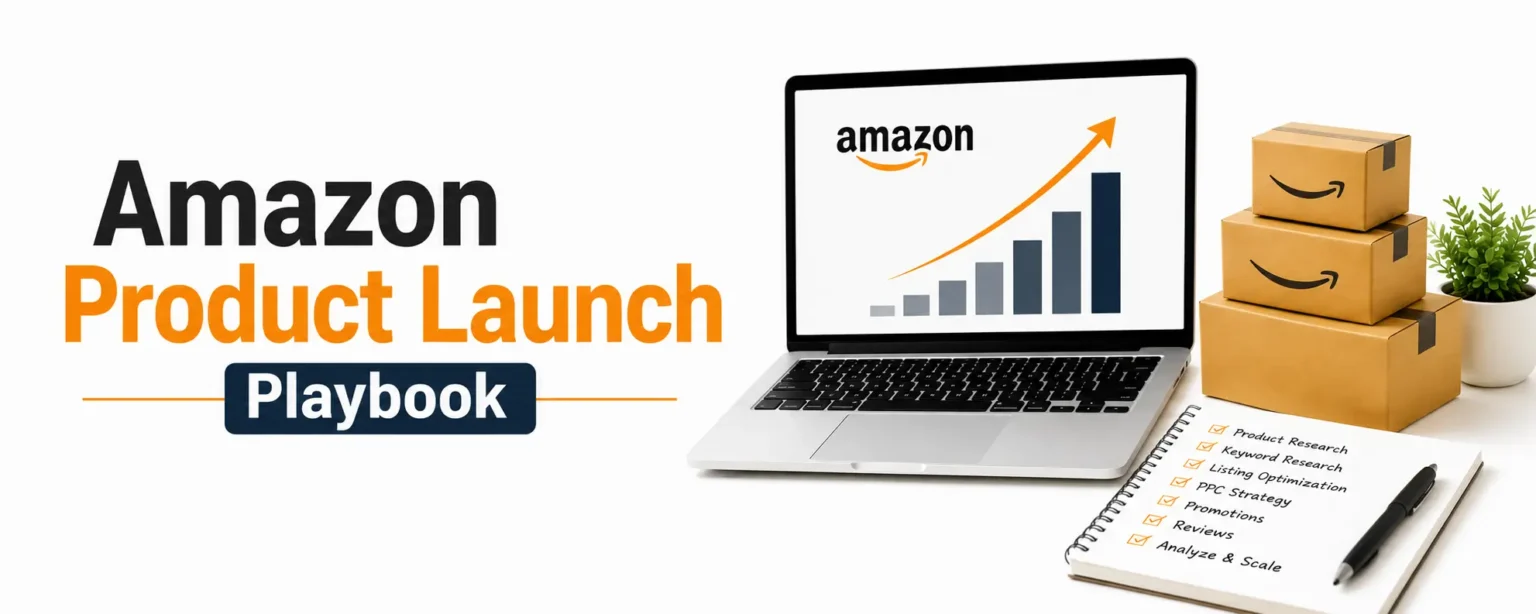
The five-phase sequence is straightforward: seed keywords before the listing goes live, build a creative asset stack that converts cold traffic, structure PPC campaigns for the first 30-day learning window, use time-bound promotions and compliant review tactics to drive early velocity, and protect inventory depth and Buy Box ownership throughout. Each phase sets up the next one. Skipping or rushing any of them weakens the others.
So what is the best strategy to launch a product on Amazon in 2026? It comes down to preparation over improvisation. The algorithm compounds early momentum from conversion rate and sales velocity signals, which means the work done before launch day determines how fast organic rank follows. A well-sequenced launch builds a flywheel. A poorly sequenced one creates a spend spiral that’s expensive to reverse.
If you want a clear-eyed assessment of where your launch foundation stands before going live, start with ZIWLD’s free listing audit. It takes the guesswork out of prioritization and tells you exactly which components need work before your ASIN goes live.
Frequently asked questions
What is the best strategy to launch a product on Amazon in 2026?
The best Amazon product launch strategy starts with thorough keyword research, a fully optimized product listing, high-quality images, A+ Content, and a well-structured PPC campaign. Combining these elements with inventory planning, compliant review generation, and performance tracking helps build early sales velocity and improve organic rankings.
How much should I spend on Amazon PPC for a new product launch?
Your Amazon PPC budget depends on your product category, competition, and sales goals. Most successful launches begin with a controlled daily budget that generates enough clicks and conversion data to optimize campaigns while improving organic visibility over time.
How important is Amazon Listing Optimization before launching a product?
Amazon Listing Optimization is one of the most important steps before launch. A keyword-optimized title, persuasive bullet points, compelling product descriptions, backend search terms, and professional images help improve visibility, increase conversions, and support higher organic rankings.
Should I use Amazon FBA when launching a new product?
For most sellers, Amazon FBA is the preferred fulfillment option because it improves delivery speed, increases Buy Box eligibility, and provides a better customer experience. These factors can positively influence product performance during the launch period.
Can an Amazon agency help improve a product launch?
Yes. An experienced Amazon agency can manage every stage of the launch process, including keyword research, listing optimization, Amazon PPC management, A+ Content, creative design, inventory planning, and performance monitoring. A coordinated launch strategy helps reduce costly mistakes and increases the chances of long-term success.