
Table of Contents
How to Choose the Best Amazon Agency for Your Brand
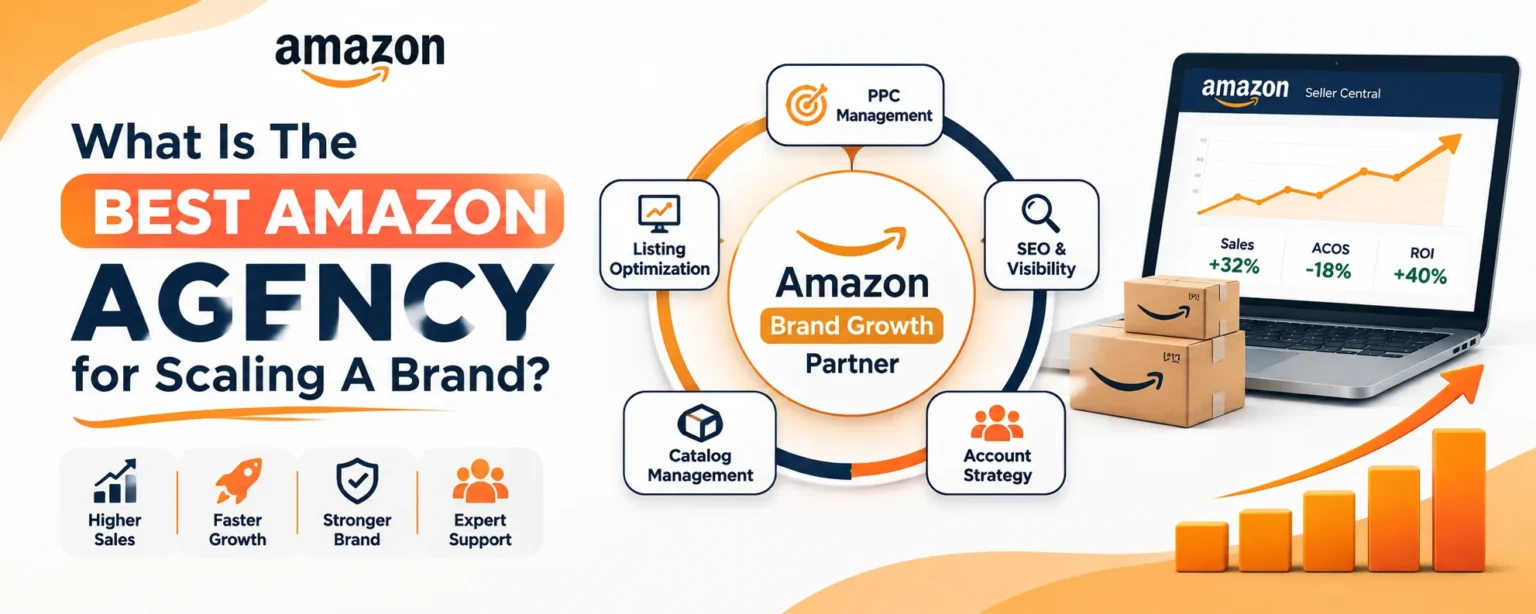
What is the best Amazon agency for scaling a brand? That question is harder to answer than it looks. There are hundreds of agencies claiming they can scale your Amazon business, but most sellers can’t tell the difference between a true growth partner and a glorified ad manager until they’ve already signed a contract and burned through several months of budget. The stakes are real: the wrong agency raises your ACOS, ignores your catalog health, and delivers reports full of metrics that don’t connect to actual revenue growth.
This guide lays out the specific criteria that separate elite Amazon growth agencies from average ones. The framework reflects what the best operators in this space actually look like in practice: integrated agencies that coordinate PPC, SEO, creative, and catalog operations under one unified growth system. By the end, you’ll have a clear shortlist of criteria, a pricing benchmark, and the exact questions to ask before you commit to anyone.
What Actually Separates Elite Amazon Agencies from Average Ones
Many agencies specialize in a single service: either PPC management, listing optimization, or creative work. The problem is that these functions don’t operate in isolation on Amazon. An ad campaign driving traffic to a listing with a weak main image and thin copy is burning budget. Elite agencies coordinate all functions so that advertising, content, and catalog decisions reinforce each other rather than work at cross purposes. This full-funnel coordination is the first filter you should apply when evaluating any Amazon marketing agency.
The second filter is whether the agency is proactive or reactive. Average agencies respond to what happens. Elite agencies anticipate it: adjusting bids before seasonal shifts, refreshing creative before conversion rates drop, and flagging suppressed listings before they become a revenue problem. Ask specifically how any prospective agency handles proactive account monitoring and what triggers their strategic interventions. Agencies that can’t answer this with specifics are managing reactively.
Case study quality is a direct signal of an agency’s standards. The best Amazon agencies publish named-client outcomes with real numbers: revenue growth percentages, TACoS reduction, conversion rate lift, and organic rank improvements. Agencies that only show vague testimonials or anonymous results should raise flags. Documented outcomes, a 49% TACoS reduction for a professional beauty brand, or a brand scaling from $18k to $165k in monthly revenue, are the standard you should be measuring against.
What Is the Best Amazon Agency for Scaling a Brand? Start with PPC Depth
A well-structured Amazon PPC campaign isn’t just Sponsored Products on auto. Elite Amazon advertising agencies build segmented campaigns by match type, funnel stage, and intent signal, then layer in Sponsored Brands and Sponsored Display to capture demand at multiple touchpoints. Ask any prospective agency to walk you through their campaign architecture for a brand at your scale. Generic answers reveal a generic approach.
How Elite Amazon PPC Agencies Manage TACoS
The agencies worth hiring talk in TACoS, not just ACOS in isolation. TACoS accounts for the relationship between ad spend and total revenue, including organic revenue, which is the only number that tells you whether paid ads are genuinely growing the business or just circulating existing demand. Any Amazon PPC agency that can’t explain TACoS management and how they balance short-term efficiency with organic rank growth is operating without the full picture.
Elite agencies know how to grow ad spend without proportionally growing wasted spend. This comes from disciplined negative keyword management, search term report analysis, and strategic budget allocation across campaign types. The difference between an agency spending $30k per month efficiently and one burning it shows up in ROAS and profit margins, not just top-line revenue. Make sure you’re asking about both.
Listing Optimization and Creative as Compounding Conversion Drivers
A great Amazon SEO listing strategy starts with keyword research that maps to how buyers actually search, not just high-volume terms. Elite agencies build listing content, title, bullets, description, and backend search terms, around a keyword architecture that improves organic rank over time. This isn’t a one-time setup task; it’s an ongoing process as the search landscape shifts and new ASINs enter the category.
A+ Content and Amazon storefront design are not cosmetic extras. They are conversion tools. Agencies that treat them as optional upsells are underestimating how much a polished brand presence affects purchase decisions, especially in competitive categories. The best full-service Amazon agencies include creative conversion assets as a core part of the growth system, not an add-on with a separate invoice.
Why Creative and PPC Have to Work Together
Better creative directly reduces cost-per-click inefficiency because higher conversion rates improve your ad relevance score and organic positioning. When an agency manages both the creative and the PPC, they can test, iterate, and optimize with full visibility into how image and copy changes affect ad performance. Siloed agencies can’t do this. That’s exactly why integration matters.
Transparent Reporting and the Integrated Growth Model
Real reporting connects every action to a business outcome. It shows you how a bid change affected ACOS, how a listing update moved organic rank, and how creative performance influenced conversion rate, not just a chart of impressions and clicks. Elite agencies deliver weekly or bi-weekly reports that are actually actionable: they tell you what happened, why it happened, and what they’re doing about it. A report with no narrative and no next steps is a red flag.
A professional weekly report should include TACoS, ACOS, ROAS, conversion rate, new-to-brand sales percentage, organic versus paid revenue split, and inventory health indicators. Monthly reports should add broader trend analysis: Brand Metrics funnel movement, keyword-level organic rank progress, and a clear recap of the strategic changes the agency made and their measured impact.
When PPC, SEO, creative, and catalog management operate under one coordinated strategy, gains compound. A keyword that gains organic traction reduces the cost of capturing that term via paid ads. A listing image improvement raises conversion, which improves organic rank, which reduces the ad spend needed to maintain visibility. ZIWLD’s integrated growth system is built around exactly this compounding dynamic. Every function is coordinated around the same growth goals and reporting cadence, rather than operating in separate silos. Catalog health fits into this same framework: suppressed listings, stranded inventory, and catalog errors silently kill revenue, and the agencies that treat these as growth functions rather than support tickets keep accounts clean and conversion-ready.
Agency Fee Structures and What Pricing Tells You
Full-service Amazon agencies typically use one of three models:
- Monthly retainers: $3,000 to $10,000 per month for mid-market brands, with enterprise-level accounts reaching $15,000 to $25,000 when DSP campaigns, international expansion, and dedicated teams are included.
- Percentage-of-ad-spend: Typically 10 to 20% of managed spend, often with a minimum monthly floor.
- Revenue share: Usually 3 to 8% of gross Amazon revenue, less common, and often paired with a base fee.
Pricing signals confidence and scope. A full-service Amazon agency charging $1,500 per month for PPC, SEO, creative, and account management is almost certainly not running a full-service model. They’re understaffed or cutting corners. Agencies confident in their results build pricing that reflects real team time and strategic depth. Before comparing prices across agencies, make sure you understand exactly what’s included in each retainer.
Watch for these red flags in contracts:
- Long-term lock-ins with no performance clauses or defined exit windows
- Agencies that own your ad account data rather than the brand
- Vague retainer scope with no itemized service breakdown
- No access to your own Seller Central or ad accounts during the engagement
Most full-service agencies require a 3 to 6 month minimum commitment, with 6 to 12 months common for integrated engagements. That’s reasonable given that meaningful organic rank improvements typically emerge between months 3 and 6, and full compounding effects across paid media and organic visibility take 6 to 12 months. But those timelines are only valid if the agency is actually executing an integrated strategy from day one.
Questions to Ask Before You Sign with Any Amazon Agency
Ask for named case studies in your product category with specific metrics over a defined time period. Request references from current or former clients, not just a Clutch profile. The best Amazon agencies for brand growth can connect you directly to real clients who will vouch for their process and communication, not just their results. Third-party review volume on Clutch or Trustpilot is a useful secondary signal, but direct references carry more weight. Agencies that publicly list hundreds of verified reviews on those platforms demonstrate consistent client experience, but you still want to talk to someone who was in the seat you’re about to sit in.
Get specific answers to these communication and accountability questions before you sign:
- How often will we meet, and who runs the meeting?
- Who owns the account day-to-day, and how do we reach them between reporting cycles?
- What does a typical weekly report include, and can you show us an example?
- How do you handle listing suppression, Buy Box issues, and inventory coordination as part of ongoing scope?
- Do we retain full ownership of our ad accounts, Seller Central access, and all reporting data?
Agencies with clear answers operate with accountability. Agencies that are vague about communication are usually vague about accountability too. Also find out whether the people managing your account are specialists or generalists, whether they use proprietary tools or only native Seller Central data, and whether their PPC, SEO, and creative teams collaborate or operate independently. The setup you’re looking for is an agency where every function is run by specialists working from a unified growth brief, not a team of generalists covering everything loosely.
Choosing the Right Partner, Not Just the Right Pitch
Figuring out what is the best Amazon agency for scaling a brand comes down to fit and operating model, not pitch deck quality or client list size. The right partner’s operating model matches the actual complexity of what Amazon requires: coordinated PPC, SEO, creative, and catalog management working from the same strategy, reported transparently, and optimized continuously.
The criteria in this guide, full-funnel integration, PPC depth, listing optimization, transparent reporting, clear pricing, and verifiable results, are the filters that separate agencies worth hiring from ones that will slow you down. Use the questions in the previous section before you sign anything, and hold every agency you evaluate to the same standard.
Many of the fastest-scaling brands on Amazon in 2026 aren’t working with the cheapest vendor or the one with the slickest sales deck. They’re working with the most integrated marketplace agency for brands, the kind that treats PPC, SEO, creative, and catalog health as one connected system, not four separate services. If you want to see what that model looks like for your catalog, request a free Amazon listing audit from ZIWLD to identify immediate improvement opportunities and show you exactly where your current setup is leaving growth on the table.
Frequently asked questions
What is the best Amazon agency for scaling a brand?
The best Amazon agency for scaling a brand is one that operates as a fully integrated partner, managing PPC, SEO, listing optimization, and catalog health under one coordinated strategy. Look for verified case studies with named clients, transparent reporting tied to business outcomes, and a team structure built around specialists rather than generalists.
What does a full-service Amazon FBA agency do?
A full-service Amazon FBA agency handles all growth-related functions on your account: paid advertising, organic ranking, creative asset development, A+ Content, storefront design, catalog management, and performance reporting. The key distinction from single-service agencies is that these functions work together rather than in isolation.
How much does a top Amazon agency charge?
Mid-market brands typically pay $3,000 to $10,000 per month on a retainer model. Enterprise-level accounts with DSP, international expansion, and dedicated teams range from $15,000 to $25,000 per month. Percentage-of-ad-spend models run 10 to 20% of managed spend. Any full-service quote under $1,500 per month should be treated as a red flag for understaffing or scope gaps.
How long does it take to see results from an Amazon growth agency?
Meaningful organic rank improvements typically emerge between months 3 and 6. Full compounding effects across paid media and organic visibility generally take 6 to 12 months. These timelines assume the agency is running a genuinely integrated strategy from the first month, not a single-service approach with limited scope.